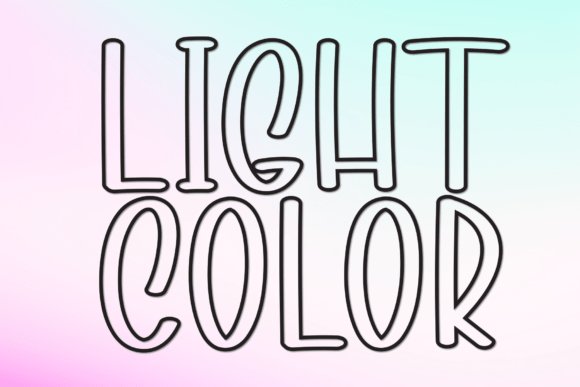
Light Color: A Playful Font with Purpose
Understanding the Unique Traits of Light Color
Light Color stands out in the world of typography with its distinct visual character. Its tall, narrow letterforms give it a clean and modern structure, while the rounded terminals add a touch of casual warmth. This font is designed with an outline-only style, offering a minimalist appearance that still manages to feel expressive and engaging. It’s especially well-suited for creative applications where a light, airy aesthetic is desired.
The font’s personality shines through in its subtle quirks—most notably in the uniquely shaped “G” and “R.” These small design choices contribute to a sense of individuality without compromising readability. Light Color maintains a consistent line weight throughout, ensuring clarity even at smaller sizes. Generous letter spacing enhances legibility and gives the font an open, breathable quality, making it a versatile choice for a variety of design contexts.
Why Light Color Resonates Across Different Audiences
Typography plays a bigger role in communication than many realize. Light Color, with its clean structure and soft curves, appeals to a wide range of users for different reasons. Whether you're a professional designer, an educator, or a hobbyist exploring digital creation, this font can serve a purpose in your work.
- Beginners appreciate its legibility and simplicity, making it a great starting point for learning how font choice affects visual messaging.
- Experienced designers find value in its flexibility—its outline style works well in layered compositions and digital illustrations.
- Educators may use it to create engaging materials that feel approachable, especially for younger audiences or informal learning environments.
- Small business owners might choose Light Color for branding materials that feel modern yet friendly, especially in niches like wellness, lifestyle, or boutique retail.
- Creative hobbyists enjoy its compatibility with coloring pages, digital stickers, and pastel-themed designs.
How to Evaluate Light Color Based on Your Needs
When considering a font for your project, it's important to match its features to your specific goals. Light Color offers a unique blend of minimalism and charm, but how useful it is depends on your priorities and application.
For ease of use: Light Color is intuitive and readable, especially when used in digital formats. Its PUA encoding allows access without specialized design software, which is a big plus for beginners or those working with limited tools.
For flexibility: The font’s outline-only style makes it ideal for layered design projects. You can fill it with color, apply gradients, or use it as a stencil effect in digital or print media.
For presentation: If you're creating content that needs to feel light and modern—like social media graphics, invitations, or digital illustrations—Light Color adds a soft, approachable tone.
For creativity: Its slightly quirky geometry opens up room for artistic exploration. The unique “G” and “R” can become focal points in logo design or custom typography.
Practical Uses Across Different Professions and Hobbies
Let’s explore how various users might apply Light Color in real-world scenarios:
Designers and Creatives
Graphic designers often look for fonts that can function both as display type and as part of a layered composition. Light Color’s outline style makes it easy to integrate into multi-layered illustrations or digital collages. It works especially well in pastel color schemes and minimalist design trends.
For example, a designer creating a set of digital stickers for a stationery brand might use Light Color as the main text style. Its airy feel complements hand-drawn elements, and the PUA encoding makes it easy to use across platforms like Canva or Procreate.
Entrepreneurs and Branding Professionals
Small business owners and marketers looking to build a youthful, approachable brand identity might incorporate Light Color into their visual materials. It’s especially effective for brands in niches like lifestyle, wellness, or handmade goods.
Imagine a boutique coffee shop using Light Color in their Instagram posts or packaging labels. The font’s casual charm aligns with a cozy, community-focused brand voice without sacrificing professionalism.
Educators and Content Creators
Teachers and educational content creators often need visuals that are clear and engaging. Light Color’s readability and friendly tone make it a good fit for infographics, presentation slides, or printable worksheets aimed at younger learners.
A homeschooling parent designing a custom spelling worksheet might choose Light Color because it feels less rigid than standard fonts like Arial or Times New Roman, helping to keep young learners visually engaged.
Hobbyists and DIY Enthusiasts
If you enjoy crafting, journaling, or creating digital art, Light Color can be a great companion. Its outline style makes it perfect for digital coloring pages, planner stickers, or printable art. The font’s PUA encoding means you can access special characters and stylistic variations without needing advanced design tools.
For instance, a hobbyist making custom greeting cards in a design app could layer Light Color text over watercolor backgrounds, using the font’s open structure to let the background colors peek through.
Is Light Color Right for You?
Choosing the right font comes down to matching its characteristics to your project’s goals and your own skill level. If you're drawn to minimalist yet expressive typography, and you work in digital or print design, crafting, or branding, Light Color is worth exploring.
Consider the following questions to help decide:
- Do you need a font that’s both readable and visually distinctive?
- Are you working on a project that benefits from an outline or stencil-style font?
- Do you value ease of access, especially if you’re not using advanced design software?
- Is your project aimed at younger audiences, casual branding, or creative hobbies?
If you answered yes to any of these, Light Color could be a strong fit. It offers a balance between structure and playfulness, making it a versatile tool in your design toolkit.
Final Thoughts
Light Color is more than just a font—it's a design element that brings personality and clarity to a wide variety of creative and professional projects. Whether you're a beginner exploring typography for the first time or a seasoned designer looking for a fresh visual voice, Light Color offers something meaningful. Its unique blend of minimalism and charm makes it a standout choice in today’s design landscape.